20 Eylül 2008 Cumartesi

Taipei 101 Taipei 101 İnformation


İnformation

Coordinates: 25°2′1″N, 121°33′52″E

Taipei 101 has been the world's tallest building since 2004.*
Preceded by Petronas Twin Towers
Information
Location Xinyi District, Taipei, Taiwan
Status Complete
Constructed 1999-2004
Height
Antenna/Spire 509.2 m (1,670.60 ft)
Roof 449.2 m (1,473.75 ft)
Top floor 439.2 m (1,440.94 ft)
Technical details
Floor count 101
Floor area 412,500 m2 (4,440,100 sq ft)
Elevator count 61, including double-deck shuttles and 2 high speed observatory elevators)
Cost NT$58 billion (US$1.76 billion)[1]
Companies
Architect C.Y. Lee & partners
Contractor KTRT Joint Venture,
Samsung Engineering & Construction
Owner Taipei Financial Center Corp.
Management Urban Retail Properties Co.

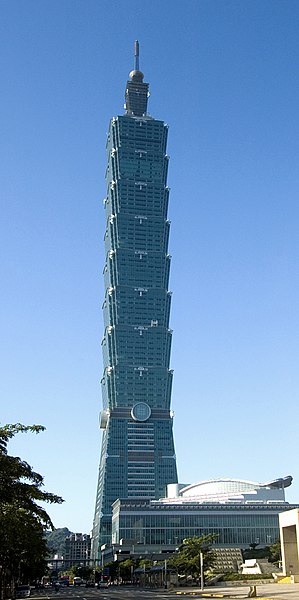
Taipei 101 (traditional Chinese: 臺北101 or 台北101; simplified Chinese: 台北101; pinyin: Táiběi Yīlíngyī; Wade-Giles: T'ai-pei I-ling-i; POJ: Tai-pak yat-leng-yat) is a 101-floor landmark skyscraper located in Xinyi District, Taipei, Taiwan. The building, designed by C.Y. Lee & partners[2] and constructed primarily by KTRT Joint Venture[3] and Samsung Engineering & Construction, is the world's tallest completed skyscraper according to the CTBUH[4] - the arbiter of tall building height. Taipei 101 received the Emporis Skyscraper Award in 2004. It has been hailed as one of the Seven New Wonders of the World (Newsweek magazine, 2006) and Seven Wonders of Engineering (Discovery Channel, 2005).[5]


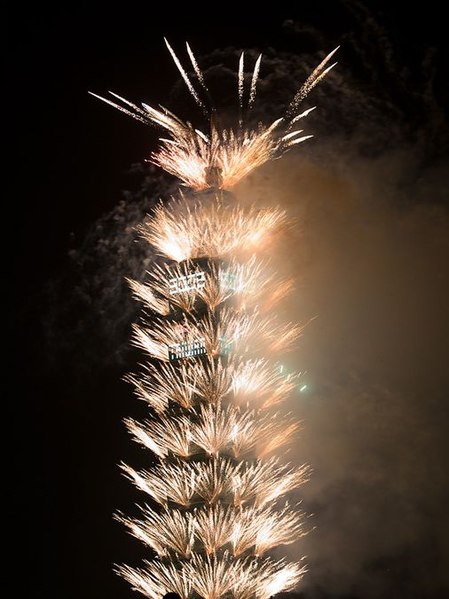
The building contains 101 floors above ground and 5 floors underground. Its postmodern style combines both Asian and international modern and traditional elements. Its safety features enable it to withstand typhoons and earthquakes. A multi-level shopping mall adjoining the tower houses hundreds of fashionable stores, restaurants and clubs. Fireworks launched from Taipei 101 feature prominently in international New Year's Eve broadcasts, and the landmark appears frequently in films, television shows, print publications, anime media, games, and other elements of popular culture.

The name of the tower reflects its location in Taipei's international business district (101 mailing code) as well as its floor count. (See also "Symbolism" below.) The number is pronounced in English simply as One Oh One and in Mandarin and other local languages by the equivalent.

Taipei 101 is owned by the Taipei Financial Center Corporation and managed by the International division of Urban Retail Properties Corporation based in Chicago. The name originally planned for the building, Taipei World Financial Center, was derived from the name of the owner. The original name in Chinese was literally, Taipei International Financial Center (traditional Chinese: 臺北國際金融中心; pinyin: Táiběi Guójì Jīnróng Zhōngxīn).

Taipei 101 was overtaken in height on July 21, 2007 by the Burj Dubai in Dubai, UAE, upon the completion of that building's 141st floor. The title of "world's tallest building" still rests with Taipei 101, though, as international architectural standards define a "building" as a structure capable of being fully occupied. The Burj Dubai is on course to claim the title once its construction is finished, expected in September 2009.

Features

Taipei 101 has 101 stories above ground and five underground. Upon its completion Taipei 101 claimed the official records for:
Ground to highest architectural structure (spire): 509.2 metres (1,670.60 ft). Previously held by the Petronas Towers 452 m (1,483 ft).
Ground to roof: 449.2 m (1,473.75 ft). Formerly held by the Sears Tower 442 m (1,450 ft).
Ground to highest occupied floor: 439.2 m (1,440.94 ft). Formerly held by the Sears Tower 412.4 m (1,353 ft).
Fastest ascending elevator speed: 16.83 m/s (55.22 ft/s) (60.6 km/h, 37.7 mi/h).
Largest countdown clock: On display every New Year's Eve.

The record for greatest height from ground to pinnacle remains with the Sears Tower in Chicago (USA): 527 m (1,729 ft).

Taipei 101 was the first building in the world to break the half-kilometer mark in height.[6] It was the first "world's tallest building" to be constructed in the new millennium.

Taipei 101 displaced the Petronas Towers in Kuala Lumpur, Malaysia, as the tallest building in the world by 57.2 m (188 ft).[7] It also displaced the 85-story, 347.5 m (1,140 ft) Tuntex Sky Tower in Kaohsiung as the tallest building in Taiwan and the 51-story, 244.2 m (801 ft) Shin Kong Life Tower as the tallest building in Taipei.[8]

The Burj Dubai, located in Dubai, UAE, overtook Taipei 101 in height upon completion of its 141st floor on July 7, 2007. The Burj Dubai is expected to hold a number of world records by the time it opens in mid-2009. Taipei 101 retains its official title until the Burj Dubai is completed, however, as the Council on Tall Buildings and Urban Habitat does not officially recognize a structure as a "building" for record purposes until it is functional--that is, until it is completed and can be occupied.

Various sources, including the building's owners,[5] give the height of Taipei 101 as 508.0 m (1,667 ft), roof height and top floor height as 448.0 m (1,470 ft) and 438.0 m (1,437 ft). This lower figure is derived by measuring from the top of a 1.2 m (4 ft) platform at the base. CTBUH standards, though, include the height of the platform in calculating the overall height, as it represents part of the man-made structure and is above the level of the surrounding pavement.[9][10]

Construction

Taipei 101 is designed to withstand the typhoon winds and earthquake tremors common in its area of the Asia-Pacific. Planners aimed for a structure that could withstand gale winds of 60 m (197 ft) per second (216 km/h, 134 mi/h) and the strongest earthquakes likely to occur in a 2,500 year cycle.[11]

Skyscrapers must be flexible in strong winds yet remain rigid enough to prevent large sideways movement (lateral drift). Flexibility prevents structural damage while resistance ensures comfort for the occupants and protection of glass, curtain walls and other features. Most designs achieve the necessary strength by enlarging critical structural elements such as bracing. The extraordinary height of Taipei 101 combined with the demands of its environment called for additional innovations on the part of engineers.

The design achieves both strength and flexibility for the tower through the use of high-performance steel construction. Thirty-six columns support Taipei 101, including eight "mega-columns" packed with 10,000-psi concrete.[12] Every eight floors, outrigger trusses connect the columns in the building’s core to those on the exterior.

These features combine with the solidity of its foundation to make Taipei 101 one of the most stable buildings ever constructed. The foundation is reinforced by 380 piles driven 80 m (262 ft) into the ground, extending as far as 30 m (98 ft) into the bedrock. Each pile is 1.5 m (5 ft) in diameter and can bear a load of 1,000 metric tons (1,100 short tons) - 1,320 metric tons (1,460 short tons).[12] The stability of the design became evident during construction when, on March 31 2002, a 6.8-magnitude earthquake rocked Taipei. The tremor was strong enough to topple two construction cranes from the 56th floor, then the highest, and killed five people in the accident. An inspection afterwards showed no structural damage to the building and construction soon resumed.

Thornton-Tomasetti Engineers along with Evergreen Consulting Engineering designed a 660 metric tons (728 short tons)[13] steel pendulum that serves as a tuned mass damper, at a cost of NT$132 million (US$4 million).[14] Suspended from the 92nd to the 88th floor, the pendulum sways to offset movements in the building caused by strong gusts. Its sphere, the largest damper sphere in the world, consists of 41 layered steel plates, each with a height of 125 mm (0.41 ft) being welded together to form a 5.5 m (18 ft) diameter sphere.[15] Another two tuned mass dampers, each weighing 6 metric tons (7 short tons),[14] sit at the tip of the spire. These prevent damage to the structure due to strong wind loads.

Taipei 101's characteristic blue-green glass curtain walls are double glazed, offer heat and UV protection, and can sustain impacts of 7 metric tons (8 short tons).[11]

Symbolism
 
Ruyi figure over a Taipei 101 entrance

Taipei 101, like all spire structures, participates in the symbolism of the axis mundi: a world center where earth and sky meet and the four compass directions join.

The height of 101 floors commemorates the renewal of time: the new century that arrived as the tower was built (100+1) and all the new years that follow (January 1 = 1-01). It symbolizes high ideals by going one better on 100, a traditional number of perfection. It represents the spot where the tower stands: 101 is the postal code of Taipei's international business district. The number also evokes the binary numeral system used in digital technology.[12]

The main tower features a series of eight segments of eight floors each. In Chinese-speaking cultures the number eight is associated with abundance, prosperity and good fortune. In cultures that observe a seven-day week the number eight symbolizes a renewal of time (7+1). In digital technology the number eight is associated with the byte, the basic unit of information.

The repeated segments simultaneously recall the rhythms of an Asian pagoda (a tower linking earth and sky, also evoked in the Petronas Towers), a stalk of bamboo (an icon of learning and growth), and a stack of ancient Chinese ingots or money boxes (a symbol of abundance). The four discs mounted on each face of the building where the pedestal meets the tower represent coins. The emblem placed over entrances shows three gold coins of ancient design with central holes shaped to imply the Arabic numerals 1-0-1.[12]

Curled ruyi figures appear throughout the structure as a design motif. The ruyi, is an ancient symbol associated with heavenly clouds. It connotes healing, protection and fulfilment. It appears in celebrations of the attainment of new career heights.[16] Each ruyi ornament on the exterior of the Taipei 101 tower stands at least 8 m (26 ft) tall. The sweeping curved roof of the adjoining mall culminates in a colossal ruyi that shades pedestrians. Though the shape of each ruyi at Taipei 101 is traditional, its metallic interpretation is plainly modern.

At night the bright yellow gleam from its pinnacle casts Taipei 101 in the role of a candle or torch upholding the ideals of liberty and welcome. From 6:00 to 10:00 each evening[17] the tower's lights display one of seven colours in the spectrum. The colours coincide with the days of the week:

The cycle through the spectrum connects the tower with the rich symbolism of rainbows, traditionally seen as bridges linking earth to sky and earth's peoples to one another.

A further connection with time appears in an adjoining park, where a clock draws its energy entirely from the building's wind shear. The circular shape of the clock is echoed in the shape of the park itself.

Taipei 101, like many of its neighbours, shows the influence of feng shui philosophy. An example appears at the intersection of Songlian Road and Hsinyi (Xinyi) Road, where a large fountain stands near the tower's east entrance.[18] A ball at the top spins toward the tower. The fountain may be viewed as a work of public art. Its stone and liquid textures offer a contrast to the glass and metal of the building even as its horizontal ridges repeat the building's rhythms. Yet, in feng shui terms, the fountain serves a practical function, though, . A T intersection near the entrance of a building drains positive energy, or ch'i, from a building and its occupants. Flowing water placed at such a spot can remedy the situation by generating a positive inward flow of ch'i. At Taipei 101 a traditional predicament has been addressed with a traditional solution--yet the result looks modern.

Taipei 101 merges ancient motifs and ideas with modern techniques and materials. As a landmark it renews the symbolism of all tall towers as cosmic centers. Its interplaying symbols convey images of optimism, abundance, and awareness of the cycles of time.

Interior
 
Taipei 101 Mall

Taipei 101 is the first record-setting skyscraper to be constructed in the twenty-first century. Appropriately it exhibits a number of technologically advanced features as it provides a center for business and recreation.

The original 2004 fiber-optic and satellite Internet connections enabled transfer speeds up to a gigabyte per second.

The doubledeck elevators built by Toshiba Elevator and Building Systems Corporation (TELC) set a new record in 2004 with top ascending speeds of 16.83 m (55.22 ft) per second (60.6 km/h, 37.7 mi/h). This speed is 34.7 percent faster than the previous record holders of the Yokohama Landmark Tower elevator, Yokohama, Japan, which speeds of 12.5 m (41 ft) per second (45.0 km/h, 28.0 mi/h). Taipei 101's elevators sweep visitors from the fifth floor to the 89th-floor observatory in only 37 seconds.[19] Each elevator features an aerodynamic body, full pressurization, state-of-the art emergency braking systems, and the world's first triple-stage anti-overshooting system. The cost for each elevator is NT$80 million (US$2.4 million).[20][21][22][23]

A 660 metric tons (728 short tons) tuned mass damper stabilizes the tower against movements caused by high winds. The damper can reduce up to 40% of the tower's movements (see "Construction").

The 101st floor is home to a private club named Summit 101. No information about this club has been made public save for a reference in the observatory pamphlet.[citation needed]

The observatories are located in the 91st and 89th floors. (See "Observatories" below.)

Two restaurants have opened on the 85th floor: Diamond Tony's, which offers European-style seafood and steak, and Shin Yeh 101 (欣葉), which offers Taiwanese-style cuisine. Occupying all of the 86th floor is Japanese restaurant XEX. [24]

The multi-story retail mall adjoining the tower is home to hundreds of fashionable stores, restaurants, clubs and other attractions. The mall's interior is modern in design even as it makes use of traditional elements. The curled ruyi symbol (see "Exterior symbolism" above) is a recurring motif inside the mall. Many features of the interior also observe feng shui traditions.

Observatories

Taipei 101 features an Indoor Observatory (89th floor) and an Outdoor Observatory (91th floor).[25] Both offer 360-degree views and attract visitors from around the world.
The Indoor Observatory stands 383.4 m (1,258 ft) above ground and can be reached by the fastest elevator in the world (at 1010 meters per minute) from the shopping mall's 5th floor - it takes only 37 seconds to arrive at the 89th floor. It offers visitors a comfortable indoor environment, large windows with UV protection, recorded voice tours in eight languages, and informative displays and special exhibits. Here one may view the skyscraper's main damper, nicknamed "Damper Baby", and buy food, drinks and gift items.
The Outdoor Observatory stands 391.8 m (1,285 ft) above ground. It is the world's highest outdoor observation deck.

Two more flights of staircase take visitors up to the Outdoor Observatory.

The Indoor Observatory is open twelve hours a day (10:00 AM-10:00 PM) throughout the week; the Outdoor Observatory is only open on special occasions and weather permitting. Tickets may be purchased on site in the shopping mall 5th floor, or in advance through the Observatory's web site (see "links" below).[26] The tickets are priced at NT$400 (US$13) each, with it one can visit the 88th (tuned mass damper area), 89th and 91th floors altogether.[27]

Art

Many works of art appear in and around Taipei 101. These include:[12]
Rebecca Horn (Germany). Dialogue between Yin and Yang. 2002. Steel, iron.
Robert Indiana (USA). Love and 1-0. 2002. Aluminum.
Ariel Moscovici (France). Between Earth and Sky. 2002. Rose de la claret granite.
Chung Pu (Taiwan). Global Circle. 2002. Black granite, white marble.
Jill Watson (Britain). City Composition. 2002. Bronze.

The Indoor Observatory hosts a regular series of exhibitions. Artists whose work has been featured include Wu Ching (gold sculpture), Ping-huang Chang (traditional painting) and Po-lin Chi (aerial photography).[28]

Tenants

A number of enterprises maintain offices in Taipei 101. A few that have been featured in public announcements[28] include these:
ABN AMRO Bank
Anthony's Group Holding Company Ltd
Bayer Taiwan
Cosmos Bank
DBS Bank Ltd
Emirates Advocates Taiwan (Emirates Trade Commission)
The Executive Centre
Fulland Securities Consultant Company Ltd (a Hantec Group subsidiary)
GoldBank of Taiwan
Google Taiwan
HVB Bank
ING Antai
ING SITE (affiliate of Internationale Nederlanden Groep N.V., or ING)
ING SCE (affiliate of Internationale Nederlanden Groep N.V., or ING)
Jones Lang LaSalle
KPMG
McKinsey & Company Taiwan
PeopleSearch Taiwan
People's King
SABIC Asia Pacific Pte Ltd
Starbucks Coffee
Taiwan Ratings Corporation
Taiwan Stock Exchange Corporation (TSEC)
Winterthur Life Taiwan

Restaurants in the tower include XEX, Diamond Tony's and Shin Yeh 101 (欣葉).[24] Hundreds of international dining establishments and retail outlets also operate in the adjoining mall.

Chronology

Important dates in the planning and construction of Taipei 101 include the following:[12]Date Event
October 20, 1997 Development and operation rights agreement signed with Taipei City government.
January 13, 1998 Ground-breaking ceremony.
August 10, 1998 Construction license awarded for 101 stories.
April 13, 1999 Design change to 509.2 m height approved by Taipei City government.
June 7, 2000 First tower column erected.
June 13, 2001 Taipei 101 Mall topped out.
May 13, 2003 Taipei 101 Mall obtains occupancy permit.
July 1, 2003 Taipei 101 Tower roof completed.
October 17, 2003 Pinnacle placed.
November 14, 2003 Taipei 101 Mall opens.
April 15, 2004 Council on Tall Buildings and Urban Habitat (CTBUH) certifies Taipei 101 as world's tallest building.
November 12, 2004 Tower obtains occupancy permit.
December 31, 2004 Tower opens to the public.
January 1, 2005 First fireworks show begins at midnight for New Year's Eve activity.

History

Planning for Taipei 101 began in 1997 during Chen Shui-bian's term as Taipei mayor. Talks between merchants and city government officials initially centered on a proposal for a 66-story tower to serve as an anchor for new development in Taipei's 101 business district. By the time the ground-breaking ceremony took place on January 13, 1998 planners were considering taking the new structure to a more ambitious height. Ten months later the city granted a license for the construction of a 101-story tower on the site. Construction proceeded and the first tower column was erected in summer 2000.

Taipei 101's roof was completed three years later on July 1 2003. Ma Ying-jeou, in his first term as Taipei mayor, fastened a golden bolt to signify the achievement. Three months later the pinnacle was placed.

The formal opening of the tower took place on New Year's Eve 2004. President Chen Shui-bian, Taipei Mayor Ma Ying-jeou and Legislative Speaker Wang Jin-pyng cut the ribbon. Open-air concerts featured a variety of popular stars such as A-Mei and Sun Yan Zi. Visitors rode the elevators to the Observatory for the first time. A few hours later the first fireworks show at Taipei 101 heralded the arrival of a new year.[29][30]

Events

Taipei 101 is the site of innumerable special events. Art exhibits, as noted above, regularly take place in the Observatory. A few noteworthy dates since the tower's opening include these.
December 25, 2004 - French rock and urban climber Alain Robert makes an authorized climb to the top of the pinnacle in four hours.[29]
February 28, 2005 - Former American president Bill Clinton visits and signs copies of his autobiography.[28]
April 19, 2005 - Tower displays the formula E=mc2 in lights to celebrate the 100th anniversary of the publication of Einstein's theory of relativity. The display, the largest of 65,000 such displays in 47 countries, is part of the international celebration Physics Enlightens the World.[28]
November 20, 2005 - First annual Taipei 101 Run Up features a race up the 2,046 steps from floors 1 to 91. Proceeds benefit Taiwan's Olympic teams. Men's race is won by Paul Crake of Australia (10 minutes, 29 seconds) and women's race by Andrea Mayr of Austria (12 minutes, 38 seconds).[28]
October 20, 2006 - Tower displays a pink ribbon in lights to promote breast cancer awareness. The ten-day campaign is sponsored by Taipei 101's ownership and Estee Lauder.[28]
December 12, 2007 - Austrian base jumper Felix Baumgartner survives an unauthorized parachute jump from Taipei 101's 90th floor.[30]
June 15, 2008 - Taipei 101 Run Up features 2,500 participants. Men's race is won by Thomas Dold of Germany (10 minutes, 53 seconds); 2007 champion Marco De Gasperi of Italy finishes second and Chen Fu-tsai of Taiwan finishes third. Women's race is won by Le

e Hsiao-yu of Taiwan (14 minutes, 53 seconds).[31][32]


Gallery

References
1^ My E Gov, The E-government Entry Point of Taiwan - Taiwan Yearbook 2005, Wikipedia - List of world's most expensive single objects
2^ Emporis - List of major designs of C.Y. Lee & partners
3^ Structuremag - Taipei 101
4^ CTBUH Tallest Database
5^ a b Taipei 101 Official Website - Awards
6^ Emporis - Taipei 101
7^ BBC NEWS - Taiwan tops out tallest building
8^ SkyscraperPage - List of skyscrapers in Taiwan
9^ CTBUH - Criteria for Defining and Measuring Tall Buildings
10^ USAToday - Taipei skyscraper deemed tallest, Paragraph abstract: The council measures from the sidewalk level of the main entrance to the skyscraper's architectural top.
11^ a b Observatory brochure, Floor 89, Taipei 101. 2007-08-17.
12^ a b c d e f Publicly posted material, Floor 89, Taipei 101. 2007-08-17.
13^ Taipei 101 Official Website - Observatory Servicing Facilities
14^ a b Taipei 101 Official Website - Tuned Mass Damper
15^ "Motioneering - Taipei 101" (PDF). Motioneering.
16^ http://www.fengshuibestbuy.com/ruyi1.html Feng Shui Bestbuy - Ru Yi
17^ Taipei 101 Official Website - Lights Schedule
18^ Boco - Taipei 101, Bigger is not Better (台北101, 更大不等於更好)
19^ Taipei 101 Official Website - Observatory Floor Guide
20^ Taipei 101 Official Website - Facts about Taipei 101
21^ Popular Mechanics - World's Fastest Elevator
22^ ArchitectureWeek - Taiwan On Top
23^ Elevator World - Breaking the 1000MPM Barrier - High speed elevators in Taipei 101
24^ a b Taipei 101 Official Website - 85F Restaurant
25^ Taipei Times - Shin Kong Tower Observatory to close by year-end
26^ Taipei 101 Official Website - Floor Guide
27^ Taipei 101 Official Website - Observatory Visit Information
28^ a b c d e f Taipei 101 Official Website -101季刊 eNewsletter
29^ BBC News - 'Spiderman' scales tallest tower", 2005-12-25.
30^ Base jumper survives leap off world’s tallest building - Times Online
31^ Afp - German wins race up world's tallest skyscraper
32^ Inquirer - German wins race up world's tallest skyscraper

Petronas Twin Towers


İnformation

Petronas Twin Towers were the world's tallest buildings from 1998 to 2004.*

Preceded by Sears Tower
Surpassed by Taipei 101
Information
Location Kuala Lumpur, Malaysia
Status Complete
Constructed 1992-1998
Height
Antenna/Spire 451.9 m (1,482.6 ft)[1]
Roof 378.6 m (1,242.1 ft)
Top floor 375.0 m (1,230.3 ft)
Technical details
Floor count 88
Floor area 395,000 m2 (4,252,000 sq ft) (1 & 2)
Elevator count 78 (1 & 2)
Companies
Architect César Pelli
Contractor Tower1: Hazama Corporation
Tower2: Samsung Engineering & Construction and Kukdong Engineering & Construction
 B.L. Harbert International
Management KLCC

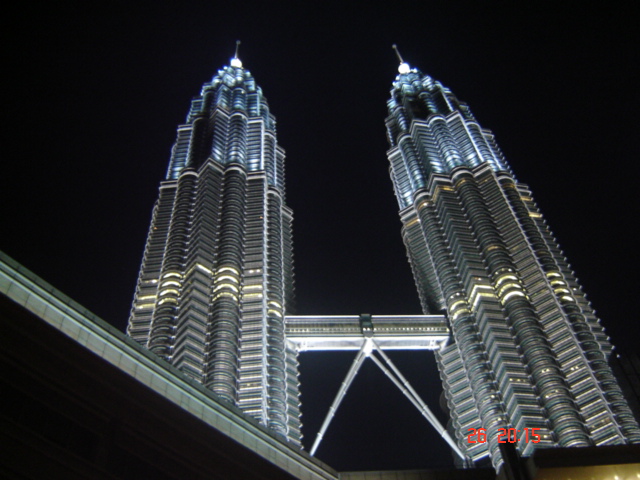
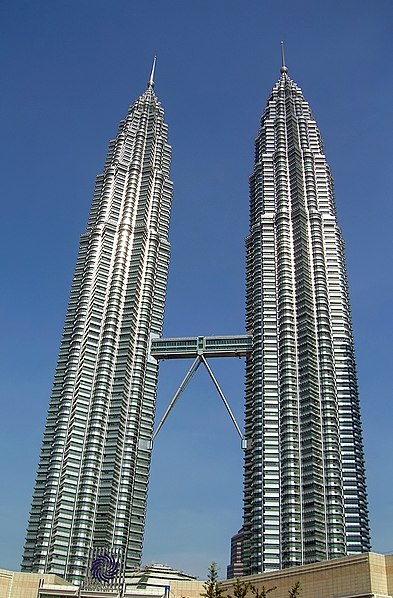
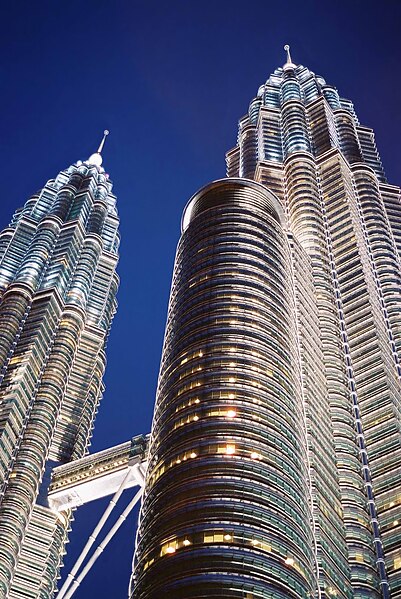
The Petronas Twin Towers (also known as the Petronas Towers or Twin Towers), in Kuala Lumpur, Malaysia were the world's tallest buildings, before being surpassed by the Taipei 101. However, the towers are still the tallest twin buildings and office building in the world. Tower 1 was built by Hazama Corporation [2] and Tower 2 by Samsung Engineering & Construction and Kukdong Engineering & Construction (both of South Korea). They were the world's tallest buildings from 1998 to 2004 if measured from the level of the main entrance to the structural top, the original height reference used by the US-based Council on Tall Buildings and Urban Habitat from 1969 (three additional height categories were introduced as the tower neared completion in 1996). [3]

Comparison with other towers


Height comparison with the Sears Tower, Taipei 101, Empire State Building and the Petronas Twin Towers

The Petronas Twin Towers were the tallest buildings in the world until Taipei 101, as measured to the top of their structural components (spires, but not antennas), took over the record. Spires are considered integral parts of the architectural design of buildings, to which changes would substantially change the appearance and design of the building, whereas antennas may be added or removed without such consequences. The Petronas Twin Towers remain the tallest twin buildings in the world.

The Sears Tower and the World Trade Center towers were each constructed with 110 occupied floors – 22 more than the Petronas Twin Towers’ 88 floors. The Sears Tower and the World Trade Center’s roofs and highest occupied floors substantially exceeded the height of the roof and highest floors of the Petronas Twin Towers. The Sears Tower’s tallest antenna is 75 m (246 ft) taller than the Petronas Twin Towers’ spires. However, in accordance to CTBUH regulations and guidelines, [4] the antennas of the Sears Tower were not counted as part of its architectural features.[5]Therefore, the Petronas Twin Towers exceed the official height of the Sears Tower by 10m, but the Sears Tower has more floors with occupied office space at a higher level.

History

Designed by Argentine-American architect César Pelli, the Petronas Towers were completed in 1998 and became the tallest buildings in the world on the date of completion. They were built on the site of Kuala Lumpur's race track. Because of the depth of the bedrock, the buildings were built on the world's deepest foundations. The 120-meter foundations were built by Bachy Soletanche, and required massive amounts of concrete.

The 88-floor towers are constructed largely of reinforced concrete, with a steel and glass façade designed to resemble motifs found in Islamic art, a reflection of Malaysia's Muslim religion. Another Islamic influence on the design is that the cross-section of the towers is based on a Rub el Hizb (albeit with circular sectors added to meet office space requirements).

In an unusual move, a different construction company was hired for each of the towers. According to both a National Geographic documentary and a Korean newspaper, Tower 2 was successfully completed by Samsung Engineering & Construction and Kukdong Engineering (both of South Korea). The builders of Tower 1, Hazama Corporation found a problem during the construction, the tower was estimated to lean 25mm on the ground with its own weight. While Hazama's work to fix the problem, Samsung and Kukdong completed their work. Finally, the Tower 2 construction team succeeded one month earlier than tower 1. [6] [7]. Due to a lack of steel and the huge cost of importing steel, the towers were constructed on a cheaper radical design of super high-strength reinforced concrete. High-strength concrete is a material familiar to Asian contractors and twice as effective as steel in sway reduction; however, it makes the building twice as heavy on its foundation than a comparable steel building. Supported by 23-by-23 meter concrete cores and an outer ring of widely-spaced super columns, the towers use a sophisticated structural system that accommodates its slender profile and provides from 1300 to 2000 square metres of column-free office space per floor.

Below the twin towers is Suria KLCC, a shopping mall, and Dewan Filharmonik Petronas, the home of the Malaysian Philharmonic Orchestra.

Petronas, Malaysia's national oil company, set out to build the world's tallest building. Although other buildings such as the Sears Tower have higher occupied floors, a higher antenna, and a higher roof, the Petronas Twin Towers' spires are classified as architectural details and rise to 452 m (1483 feet), giving it the greatest structural height until Taipei 101. Taking advantage of the rules governing building measurements (counting spires but not antennas) has generated controversy over the towers' claim to the title. However, the tradition of including the spire on top of a building and not including the antenna dates back to the rivalry between the Chrysler Building and the 40 Wall Street.

Other buildings have used spires to increase their height but have always been taller overall to the pinnacle when trying to claim the title. In the aftermath of the controversy, the rules governing official titles were partially overhauled, and a number of buildings re-classified structural antenna as architectural details to boost their height rating (even though nothing was actually done to the building).

Tenants of the Petronas Twin Towers

Tower One is fully occupied by the Petronas Company and a number of its subsidiaries and associate companies. The office spaces in Tower Two are mostly available for lease to other companies. A number of companies have offices in Tower Two, including Accenture, Al Jazeera English, Carigali Hess Bloomberg, Boeing, IBM, Khazanah Nasional Berhad, McKinsey & Co, TCS, Krawler Networks, Microsoft, and Reuters.


KLCC Park

Spanning 17 acres below the building is the KLCC park with jogging and walking paths, a fountain with incorporated light show, wading pools, and a children's playground.

Suria KLCC is one of the largest shopping malls in Malaysia.

Skybridge

The towers feature a skybridge (constructed by Kukdong Engineering & Construction of South Korea) between the two towers on 41st and 42nd floors, which is the highest 2-story bridge in the world. The bridge is 170m above the ground and 58 m long, weighing 750 tons. The same floor is also known as the podium, since visitors desiring to go to higher levels have to change elevators here. The skybridge is open to all visitors, but free passes (limited to 1700 people per day) must be obtained on a first-come, first-served basis. The Skyway is closed on Mondays. Visitors are only allowed on the 41st floor as the 42nd floor can only be used by the tenants of the building.

The skybridge also acts as a safety device, so that in the event of a fire or other emergency in one tower, tenants can evacuate by crossing the skybridge to the other tower. However, the total evacuation triggered by a bomb hoax on September 12, 2001 (the day after the September 11 attacks destroyed the Twin Towers of the World Trade Center in New York City) showed that the bridge would not be useful if both towers need to be emptied simultaneously, as the capacity of the staircases was insufficient for such an event. Plans thus call for the lifts to be used if both towers need to be evacuated, and a successful drill following the revised plan was conducted in 2005.


The Lift System


The main bank of Otis lifts is located in the centre of each tower. All main lifts are double-decker with the lower deck of the lift taking passengers to odd numbered floors and upper deck to even numbered floors. In order to access an even numbered floor from ground level, passengers are required to use an escalator to access the upper deck of the elevator.

From the ground floor, there are three groups of lifts. The "short haul" group of 6 lifts take passengers to floors between level 2/3 and level 16/17. The "mid haul" group of 6 lifts take passengers to floors between level 18/19 and level 37/38. There is also a set of shuttle lifts that take passengers directly to levels 41/42. In order to get to levels above 41/42, passengers are required to take the shuttle lifts and then change lifts to the upper floors. These connecting lifts are placed directly above the lifts serving levels 2 to 38. The pattern now repeats with the upper levels, one set serving =levels 43/44 to 57/58 and one set serving levels 59/60 to levels 73/74.

Apart from this main bank of lifts, there are a series of "connecting" lifts to take people between the groups. Unlike the main lifts, these are not the double-decker type. Two lifts are provided to take people from levels 37/38 to levels 41/42 (levels 39 and 40 are not accessible as office space). This avoids the need for someone situated at the lower half of the building to go down to the ground floor in order to gain access to the upper half of the building.

The lifts contain a number of safety features. It is possible to evacuate people from a lift stuck between floors by manually driving one of the adjacent lifts next to it and opening a panel in the wall. It is then possible for people in the stuck lift to walk between elevator cars.

During an evacuation of the buildings, only the shuttle lift is allowed to be used. This is because there are only doors at levels G/1 and levels 41/42 therefore should there be a fire in the lower half of the building, this enclosed shaft would remain unaffected.


Service building

The service building is to the east of the Petronas Towers and contains the services required to keep the building operational, such as dissipating the heat from the air-conditioning system for all 88 levels in both towers.


Notable events

On March 20, 1997, French urban climber, Alain "Spiderman" Robert, using only his bare hands and feet and with no safety devices, scaled the building's exterior glass and steel wall. Police arrested him at the 60th floor, 28 floors away from the "summit". He made a second attempt on March 20th 2007, exactly 10 years later, and was stopped once again on the same floor (though on the other tower).[8]

On the evening of Friday, November 4, 2005, a fire broke out in the cinema complex of the Suria KLCC shopping centre below the Petronas Twin Towers, triggering panic among patrons who fled screaming and coughing in the thick, acrid smoke. There were no reports of injuries. The buildings were largely empty (except the shopping mall, Suria KLCC) because of the late hour; the only people affected were moviegoers and some diners in restaurants.[9]


Popular culture

The Petronas Towers were a setting for some scenes in the 1999 film Entrapment starring Sean Connery and Catherine Zeta-Jones. It ends in a dramatic pursuit of the two stars by Pasukan Gerakan Khas as SWAT teams, eventually leading to Connery's capture and Zeta-Jones's escape. The towers also feature in three levels of the game Hitman 2: Silent Assassin. The player travels from one tower to another using the sky bridge, though it is unlike the real sky bridge; instead of being a narrow passageway, the sky bridge is wide and entered by breaking a panel of glass. Episode 22 from the anime series Cowboy Bebop shows what closely resembles the Petronas Twin Towers being blown up by a terrorist. This episode was taken off the air for a short time post-9/11. The Petronas Towers are also a major setting in the 2006 Bollywood film,Don - The Chase Begins Again, starring Shah Rukh Khan. A major fight takes place on the towers.

References This article needs additional citations for verification.
Please help improve this article by adding reliable references. Unsourced material may be challenged and removed. (December 2006)

Gallery

References

1^ Petronas Twin Towers Official Website - General Statistics
2^ Official website of Hazama Corporation"Hazama Corporation is in charge of constructing Tower 1"
3^ Council on Tall Buildings and Urban Habitat preamble to High Rise Database: other measurements of height"
4^ http://www.ctbuh.org/Resources/Resources-HighRiseDatabase.aspx
5^ The Sears Tower
6^ Secret of Petronas Twin Towers, Metroseoul(Korean) Hazama Corporation (Japan) has worked on 'Tower 1' and they found serious problem. The building was leaning 25mm on the ground. While Japanese fix this problem, Samsung and Kukdong (both of South Korea) is fully completed building without problem. Moreover, Japanese has failed to complete a spire until the end of scheduled time. While Japan construction team has a deep sleep, the South Korean construction team succeeded in establishing a spire.
7^ Petronas Twin Towers, National Geographic Channel Broadcast. (Video : 36:02~36:13) "25mm problem....Tower 1 wasn't straight."
8^ 'Spiderman’ has another go at Twin Towers, The Star, March 21, 2007.
9^ Fire Forces Evacuation at Malaysia Towers, CBS News, November 4, 2005.


Petronas Kuleleri


Petronas Kuleleri, Malezya'da Petronas petrol holdingine ait ikiz kuleler. Toplam 452 m yükseklikle başkent Kuala Lumpur 'da gökyüzüne yükselirler.


1996 yılından, 2003 yılındaki Taipei 101 binasının inşasına kadar, birçok gökdelen listelemesinde, Dünya'nın en yüksek yapısı olarak kabul ediliyordu. Ancak en yüksek katı 378 m, çatısı 403 m olan bina için bu sınıflandırma çok tartışmalıdır. Zira bu her iki noktada da Sears Kulesi (412 m ve 442 m) daha uzun olduğu gibi, anten dâhil toplam yüksekliği ise 527 m'dir.

170.m yükseklikte 41 ve 42.ci katlar arasındaki çelik köprü ile kuleler birbirine bağlıdır. Köprü 2000 yılında kullanıma açılmıştır. Uzunluğu 58 m olan bu köprü 750 ton ağırlığındadır. Köprünün ziyareti için ücretsiz verilen o günün sabahı 8.30'da dağıtılır ve genelde 2 saat içinde hepsi tükenir.(ücretsiz olan nedir? Tükenen nedir?) Kulelerin en uç çatısı ziyarete açık değildir.

Kuleler, birçok alış veriş merkezi, doğal bilimler müzesi "Petrosains" , bir senfoni orkestrası, bir sanat galerisi ve birçok büro için alan sağlamaktadır.

Kulelerden her biri 76 asansöre sahip olup, bunların 29 tanesi her seferinde 26 kişi taşıyan çift katlı asansörlerdir.İnşaat için 37.000 Ton çelik kullanılan yapıda 32.000 de pencere vardır.

Mimari tasarımı "César Pelli & Associates Architects" mimarlık bürosu yapmıştır. Büro bu işinde , daha önce yaptıkları kule projelerinde ki tecrübelerini kullanmıştır. Mesela bunlardan biri, inşası gerçekleşmeyen Chicago'da ki "Miglin-Beitler Skyneedle" projesidir. Her iki kule de eşit karakeristik özellikler gösterir. Mimar César Antonio Pelli, çelik, beton ve camdan islami mimariyi temel alan bir yapı meydana getirmiştir.

Petronas kuleleri öncelikli olarak iş binası olarak tasarlanmış olup , geleneksel ikiz konseptiyle , New York'daki Dünya Ticaret Merkezi'ne (World Trade Center) benzetilebilir.

Kuleleri en güzel gören manzara, 421 m yükseklikteki Menara Kuala Lumpur'dendir (Manera Kuala Lumpur TV kulesi).Menara KL, bir tepenin üzerinde bulunduğundan, Petronas Kuleleri'nin de üstünden yükselir. Böylelikle buradan 2 devasa kuleye yukardan bir bakış sağlanır ki bu manzara geceleyin daha da etkileyicidir.

Genel Bilgiler
Yer Kuala Lumpur, Malezya
Kullanım Alanı İş Merkezi
İnşa Tarihi 1992-1998
Mimar César Antonio Pelli
İnşa Maliyeti -
Teknik Bilgiler
Yükseklik {{{Yükseklik}}}
İnşa Alanı 341.760 m²
Kat Sayısı 88
Dünya Sıralaması 2

Chrysler Building Commentary

"Art Deco in France found its American equivalent in the design of the New York skyscrapers of the 1920s. The Chrysler Building...was one of the most accomplished essays in the style."

— John Julius Norwich, ed. The World Atlas of Architecture. p366. 

"The design, originally drawn up for building contractor William H. Reynolds, was finally sold to Walter P. Chrysler, who wanted a provocative building which would not merely scrape the sky but positively pierce it. Its 77 floors briefly making it the highest building in the world—at least until the Empire State Building was completed—it became the star of the New York skyline, thanks above all to its crowning peak. In a deliberate strategy of myth generation, Van Alen planned a dramatic moment of revelation: the entire seven-storey pinnacle, complete with special-steel facing, was first assembled inside the building, and then hoisted into position through the roof opening and anchored on top in just one and a half hours. All of a sudden it was there—a sensational fait accompli."

— Peter Gossel and Gabriele Leuthauser. Architecture in the Twentieth Century. p209.

"One of the first uses of stainless steel over a large exposed building surface. The decorative treatment of the masonry walls below changes with every set-back and includes story-high basket-weave designs, radiator-cap gargoyles, and a band of abstract automobiles. The lobby is a modernistic composition of African marble and chrome steel."

— Elliot Willensky and Norval White. AIA Guide to New York City. p121.

Details

Client: William P. Chrysler, the automotive magnate.

77 stories or floors.The height to the top of its spire is 1048 feet.

Address

405 Lexington Avenue (between 42nd and 43rd streets)
New York, New York

9 Eylül 2008 Salı

Need For Speed Underground 2

Need For Speed Underground 2

http://rapidshare.com/files/5719526/....net.part1.rar
http://rapidshare.com/files/5746862/....net.part2.rar
http://rapidshare.com/files/5850096/....net.part3.rar

Rar Şifresi : uncity.pl

The Comparative Literature of Massive Construction Sites


The Comparative Literature of Massive Construction Sites

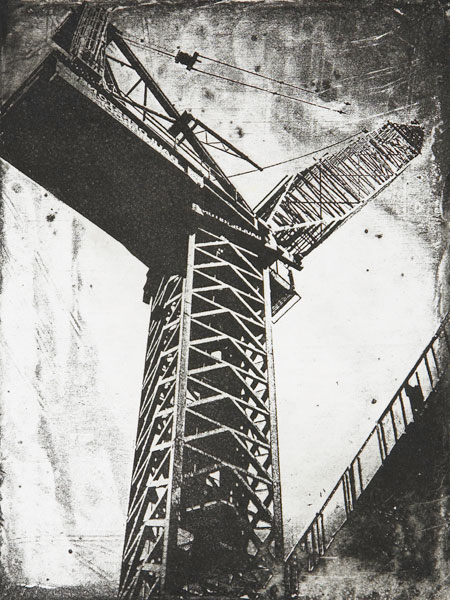
[Image: An etching by Daniel Stojkovich called Tower of Babel 2, exhibited as part of Top Arts 2007 at the National Gallery of Victoria, Australia].

I was clicking around on a local university's engineering school homepage yesterday morning when I misunderstood the way the page had been organized. For a second I thought that Comparative Literature had been re-classified as a sub-field, or specialty research group, within the university's engineering school – and so I had to wonder what exactly those students might be reading.
Aside from technical manuals, what might be the comparative literature of engineering?
Before I realized that I'd simply misread the list of links, I thought that perhaps there should be a comparative literature of construction sites: famous monuments, tombs, bridges, houses, and cities throughout history, together with the thoughts of the people who built them.
You collect the oral histories of construction workers all over the world, only identifying what building they were working on in the footnotes; what emerges is a kind of architectural hivework with no clear purpose or outline taking shape all over the planet, with towers and stadiums and whole urban neighborhoods assembled in a fog of exhaustion and low-grade injury.
You then go back through all of literature, from the Bible to the Upanishads to The Odyssey to The New York Times, culling long quotations about construction sites. The private houses of emperors; the pyramids; recollections of the construction of jungle temples; mountain lookouts in a time of war; Victorian train lines; Dubai.
In fact, I'm reminded of the excellent book Dart by Alice Oswald in which conversations with people living along the river Dart have been combined into a single, long-running commentary about the riverine landscape; only here it would be a kind of Dart of architecture: thousands and thousands of construction workers and site engineers and geotechnicians and consultant elevator repair servicepersons all speaking about the act of putting architecture together in space.
Epic poems of building assembly.
I do wonder, meanwhile, if the temporary micro-culture of the construction site has been adequately documented by architectural historians. Industrial yards have certainly had their day, from documentaries about WWII dockworkers to historical surveys of Solidarity; and construction sites have obviously long been a focus for painters and photographers.
But have literature and history given the attention due to sites of architectural assembly?
Do we need a Construction Site Reader – the comparative literature of massive construction sites?

The Comparative Literature of Massive Construction Sites


The Comparative Literature of Massive Construction Sites

[Image: An etching by Daniel Stojkovich called Tower of Babel 2, exhibited as part of Top Arts 2007 at the National Gallery of Victoria, Australia].

I was clicking around on a local university's engineering school homepage yesterday morning when I misunderstood the way the page had been organized. For a second I thought that Comparative Literature had been re-classified as a sub-field, or specialty research group, within the university's engineering school – and so I had to wonder what exactly those students might be reading.
Aside from technical manuals, what might be the comparative literature of engineering?
Before I realized that I'd simply misread the list of links, I thought that perhaps there should be a comparative literature of construction sites: famous monuments, tombs, bridges, houses, and cities throughout history, together with the thoughts of the people who built them.
You collect the oral histories of construction workers all over the world, only identifying what building they were working on in the footnotes; what emerges is a kind of architectural hivework with no clear purpose or outline taking shape all over the planet, with towers and stadiums and whole urban neighborhoods assembled in a fog of exhaustion and low-grade injury.
You then go back through all of literature, from the Bible to the Upanishads to The Odyssey to The New York Times, culling long quotations about construction sites. The private houses of emperors; the pyramids; recollections of the construction of jungle temples; mountain lookouts in a time of war; Victorian train lines; Dubai.
In fact, I'm reminded of the excellent book Dart by Alice Oswald in which conversations with people living along the river Dart have been combined into a single, long-running commentary about the riverine landscape; only here it would be a kind of Dart of architecture: thousands and thousands of construction workers and site engineers and geotechnicians and consultant elevator repair servicepersons all speaking about the act of putting architecture together in space.
Epic poems of building assembly.
I do wonder, meanwhile, if the temporary micro-culture of the construction site has been adequately documented by architectural historians. Industrial yards have certainly had their day, from documentaries about WWII dockworkers to historical surveys of Solidarity; and construction sites have obviously long been a focus for painters and photographers.
But have literature and history given the attention due to sites of architectural assembly?
Do we need a Construction Site Reader – the comparative literature of massive construction sites?

Gılgamış Destanı (pdf)

Gılgamış Destanı (pdf)
Gılgamış Destanı, tarihin en eski yazılı destanının adı olup, 12 kil tablete Akad çivi yazısı ile kaydedilmiştir. Uruk kralı Gılgamış'ın ölümsüzlüğü arayışının öyküsü anlatılmaktadır. Destana konu olan kral Gılgamış gerçekten yaşamış ve MÖ. 28. yüzyılda Mezopotamya’daki Uruk kentinde hüküm sürmüştür. Ölümsüzlüğün ve bilginin peşindeki insanı yücelterek anlatan Gılgamış Destanı, Gılgamış'ın ölümünden bin yıl kadar sonra yazılmıştır ve günümüze kadar gelebilmiştir.
Destan, Akad ve Sümer mitolojilerinde geçer ve Akad dilinde yazılmış 12 tabletten oluşmaktaysa da bulunamayan tabletlerde destana ek bölümlerin olduğu sanılmaktadır. Aslında bir tablet daha bulunmuştur ancak olayların sırasına uymamaktadır ve bu yüzden ayrı bir versiyon olduğu düşünülmektedir. 1855’te Ninova’da yapılan kazılarda, Asur Kralı Asurbanipal’in M.Ö. 7. yüzyılda derlettirdiği tabletler bulunmuş, daha sonra Türkiye-İran sınırında ve Irak’taki Nippur antik kenti kazılarında bulunan tabletler de eklenmiştir. Ayrıca Türkiye’de Sultan Tepe ve Boğazköy’de yapılan kazılarda da destanın izi bulunmuşsa da henüz tümü gün ışığına çıkarılmamıştır.
kitap 90'larda Cumhuriyet Gazetesi'nin verdiği nüshadır. Ancak kapağı yırtıldığı için, başka bir kapak taradım.


http://rapidshare.com/files/11442399...is_destani.rar


şifre: darkmalt1

Servers at Sea

Servers at Sea

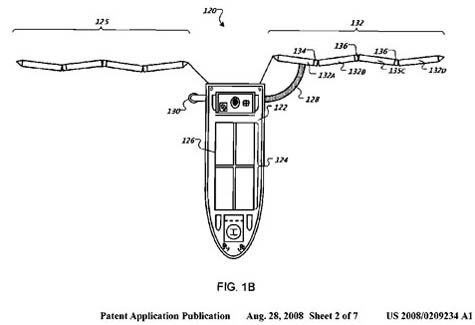
Google has filed a patent for what the New York Times describes as "mobile data center platforms out at sea."

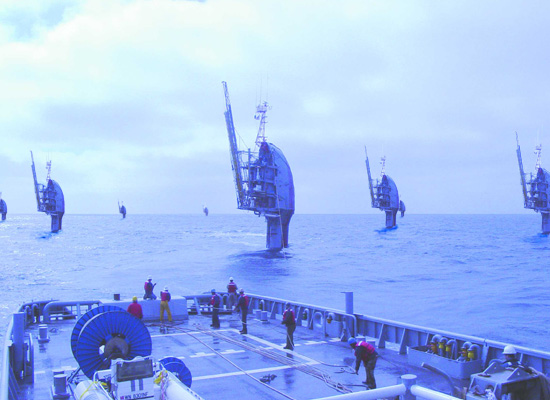
[Image: A view of the R/P FLIP ship, which has absolutely nothing to do with Google's offshore server plan; it just looks cool and seems appropriate. Image altered by Alexander Trevi].

This means "stacking containers filled with servers, storage systems and networking gear on barges or other platforms." These would be "'crane-removable' data center modules on ships." From the actual patent application:
    In general, computing centers are located on a ship or ships, which are then anchored in a water body from which energy from natural motion of the water may be captured, and turned into electricity and/or pumping power for cooling pumps to carry heat away from computers in the data center.
Perhaps unsurprisingly in this era of alternative energy sources, "Google has theorized about powering these ocean data centers with energy gained just from water splashing against the side of the barges."

[Image: From Google's patent application for servers at sea; via the New York Times].
I have to assume, then, that we're moving ever closer to true deep-water city-states – only they won't be libertarian ocean-going homesteads, after all, they'll be distributed networks of supercomputing villages afloat on, and drawing power from, the tides.
Two weeks ago, meanwhile, the NYTimes also looked at the privatization of civic infrastructure – but perhaps Google's literally offshore experiment in information technology implies a coming world of privatized services at sea.
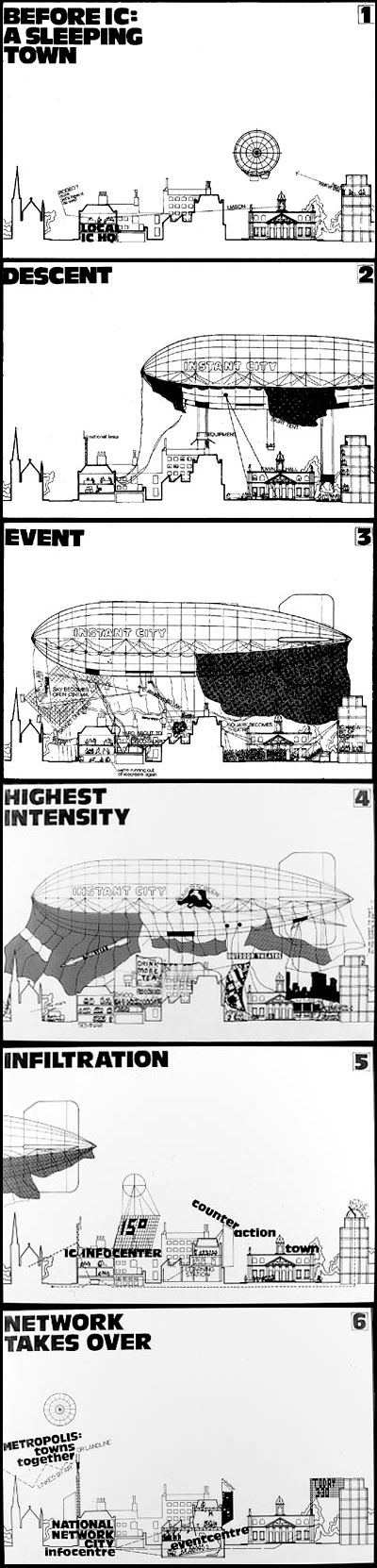
A fleet of tankers shows up in a nearby port one day... and suddenly your city has telephone services. It's Archigram's instant city all over again, but on the level of specific – and highly billable – urban amenities.
The services show up. The network takes over.
Your city will never be the same.

[Image: The Instant City at work; diagrams by Peter Cook/Archigram. An original interview with Peter Cook appears in the forthcoming BLDGBLOG Book].

I'm further reminded of the five-week-long power outage that struck Auckland, New Zealand, just slightly more than ten years ago. Peter Gutmann describes some of the possible ship-borne solutions to that city's loss of electricity:
    Apparently the idea of moving ships from the naval base on the other side of the harbour across to the Auckland waterfront to act as floating generators was considered, but there are problems with feeding the power from the ships to the city. There's also the problem that there's nothing around which can generate even a fraction of the power required. Another idea which was considered is using one of the Cook Straight ferries (which could in theory provide around 10MW) as a floating generator (the term "ferry" is a considerable understatement). Currently a couple of waterfront businesses are being run with power from ships acting as floating generators, and when both repaired cables failed their testing, Mercury finally brought in a diesel-electric trans-Tasman freighter, the Union Rotorua, to act as a 12MW floating generator, and is considering bringing in another ship or installing generators on barges.
In any case, the seafaring future of civic infrastructure is something we'll have to keep our eyes on. Entire new untold types of urban experience could be yours the minute that strange shape on the horizon comes in to dock.

2 Ağustos 2008 Cumartesi

Gılgamış Destanı (pdf)

Gılgamış Destanı (pdf)

Gılgamış Destanı, tarihin en eski yazılı destanının adı olup, 12 kil tablete Akad çivi yazısı ile kaydedilmiştir. Uruk kralı Gılgamış'ın ölümsüzlüğü arayışının öyküsü anlatılmaktadır. Destana konu olan kral Gılgamış gerçekten yaşamış ve MÖ. 28. yüzyılda Mezopotamya’daki Uruk kentinde hüküm sürmüştür. Ölümsüzlüğün ve bilginin peşindeki insanı yücelterek anlatan Gılgamış Destanı, Gılgamış'ın ölümünden bin yıl kadar sonra yazılmıştır ve günümüze kadar gelebilmiştir.
Destan, Akad ve Sümer mitolojilerinde geçer ve Akad dilinde yazılmış 12 tabletten oluşmaktaysa da bulunamayan tabletlerde destana ek bölümlerin olduğu sanılmaktadır. Aslında bir tablet daha bulunmuştur ancak olayların sırasına uymamaktadır ve bu yüzden ayrı bir versiyon olduğu düşünülmektedir. 1855’te Ninova’da yapılan kazılarda, Asur Kralı Asurbanipal’in M.Ö. 7. yüzyılda derlettirdiği tabletler bulunmuş, daha sonra Türkiye-İran sınırında ve Irak’taki Nippur antik kenti kazılarında bulunan tabletler de eklenmiştir. Ayrıca Türkiye’de Sultan Tepe ve Boğazköy’de yapılan kazılarda da destanın izi bulunmuşsa da henüz tümü gün ışığına çıkarılmamıştır.
kitap 90'larda Cumhuriyet Gazetesi'nin verdiği nüshadır. Ancak kapağı yırtıldığı için, başka bir kapak taradım.


http://rapidshare.com/files/11442399...is_destani.rar


şifre: darkmalt1